Voting
Voting is the primary action validators perform to evaluate tasks and influence protocol outcomes. Each vote directly affects a validator’s performance, their reputation with the voters, and ultimately their rewards.
Voting lifecycle
- Commit phase
Validators commit a hidden message with their vote to Overlap before anyone else reveals. - Reveal phase
Once the commit window closes, validators reveal their votes to the protocol. - Consensus calculation
Once all votes are reveale computes achieved consensus by the validators. - Reward & penalty distribution
Validators within 1-sigma of the consensus receive rewards for their task and a performance boost. Outlier validators are penalised proportionally to their deviation. - Ranking impact
Expect performance updates to propagate to the ranking table. Voters favor consistent high-quality validators.
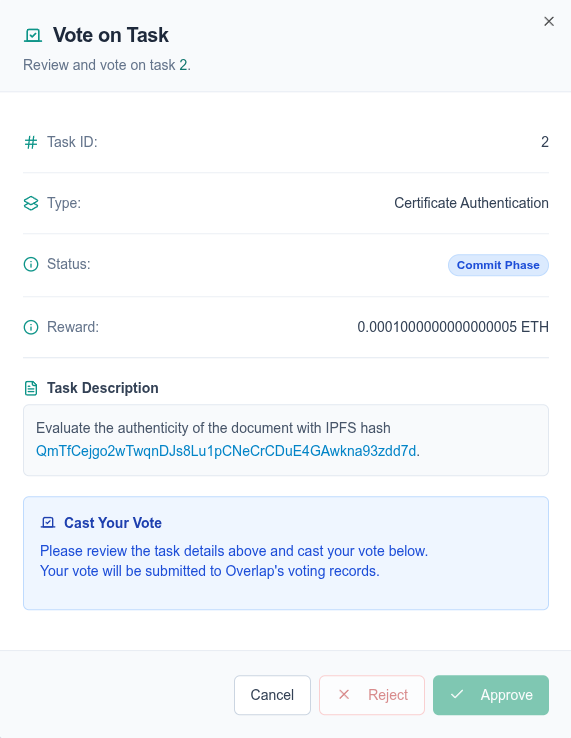
Binary vs non-binary voting
Tasks in Overlap are either Binary or Non-Binary:
- Binary Tasks – Can be resolved by a simple approve / reject decision.
- Non-binary Tasks – Require a quantative outcome such as a percentage or scalar value over a list of evaluation criteria.
Pay close attention to the task description
Each task description explicitly states the scope of the evaluation and whether a task should be binary or non-binary.
Voting is where reputation is earned. Consistent, accurate participation avoids penalties, attracts more votes, elevates your ranking, and maximises your rewards.