Penalty
The penalty system determines consequences for voting deviations based on statistical distribution analysis. Starting with consensus formation for all decisions, penalties are applied to outliers who fall outside acceptable voting ranges, creating incentive mechanisms for alignment with majority decisions.
Penalty mechanics
In Overlap, the penalty system operates based on statistical analysis of voting patterns. If you vote within 1-sigma from the center of the histogram of votes, you get no penalty and your performance increases. The system analyzes the distribution of all votes to identify the consensus center and acceptable deviation ranges. When a majority forms around a decision, validators within the acceptable range receive their share of rewards while maintaining or increasing performance scores.
- Votes within 1-sigma of consensus center receive no penalty and performance increases.
- Majority formation triggers reward distribution to aligned validators.
- Outlier votes outside the 1-sigma zone face penalties proportional to their deviation.
- Both the performance index and the user's deposit are penalized proportionally.
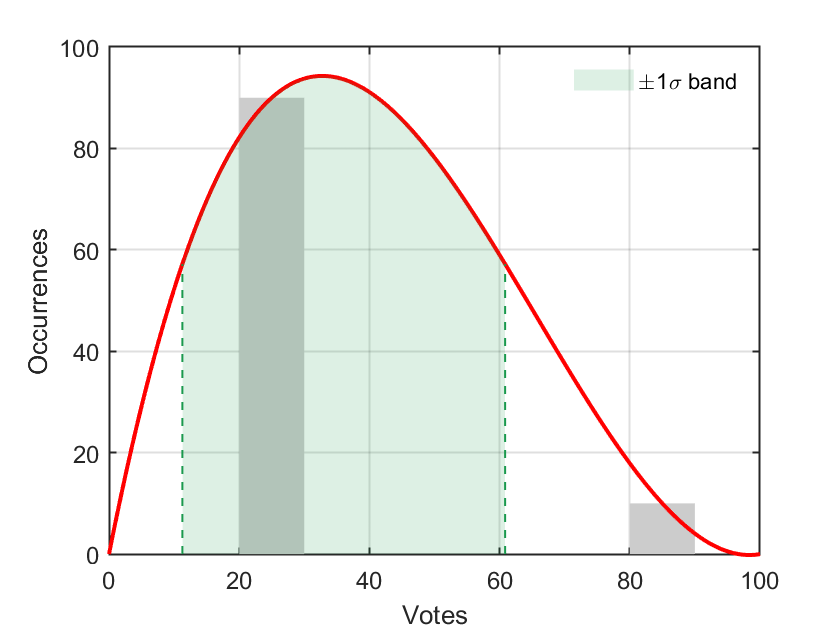
Zone of validity around the majority vote
The histogram shows 90 voters forming consensus around a vote of 25 and 10 voters deviating significantly with a vote of 85. These 10 outliers voted outside the 1-sigma boundary formed around the majority vote and are therefore penalized. The penalty is applied proportionally to each voter based on the distance of their vote from the formed majority.
What happens as penalties grow?
As penalties increase and accumulate, the validator's performance decreases and their initial deposit is slashed. As the performance index decreases, it becomes less likely for the validator to be assigned to new tasks. When the deposit is slashed below a minimum threshold, the validator is effectively frozen from being assigned to new tasks.
To reinstate their status, the user must refund their account with the initial deposit. Once the deposit is received, the previous performance index and votes are fully restored and the validator is able to participate in the voting mechanism again.
Key consequences:
- Performance index decreases as penalties accumulate
- Initial deposit is progressively slashed with penalties
- Performance index set to zero when deposit is depleted
- The validator is frozen from participating in new tasks
- Validator can reinstate their status by depositing the initial amount
Penalties are applied proportional to deviation and target outliers by slashing deposits and decreasing performance index.